

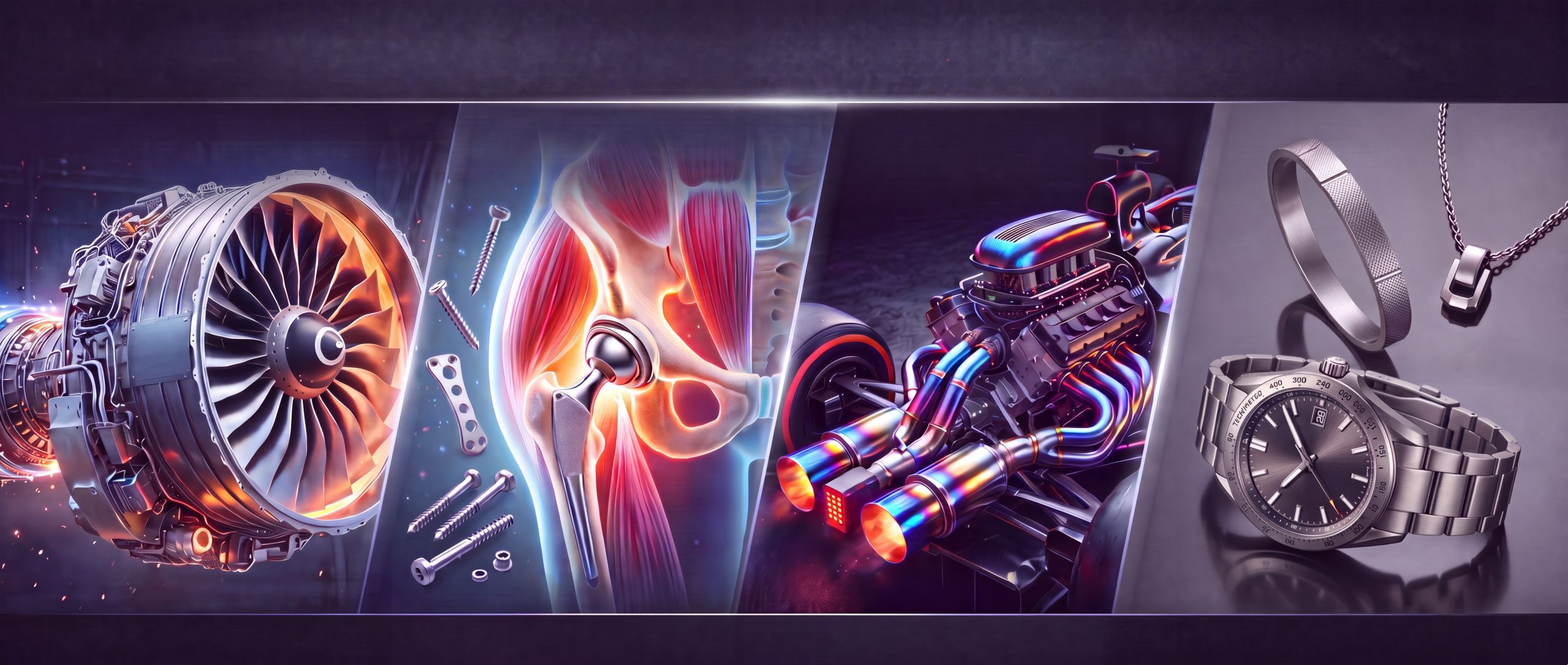
Titanium is one of the toughest, most versatile metals available. Strong, lightweight, and highly resistant to corrosion, it’s used across a remarkable range of industries — often in places you wouldn’t expect. Below is the complete guide to what titanium is used for, from heavy industry to everyday life.
Why Is Titanium So Widely Used?
Titanium’s popularity comes down to a rare combination of properties. Compared to steel, it’s around 30% stronger while being approximately 45% lighter, making it far easier to work with in demanding applications. It’s also highly resistant to corrosion, even at extreme temperatures, and biocompatible enough to be used safely inside the human body. This versatility is why titanium appears across such a diverse range of industries.
Aerospace Applications of Titanium
Titanium is one of the most critical materials in aircraft manufacturing. Its ability to withstand extreme temperatures and pressures without losing structural integrity makes it essential for:
- Aeroplane wings, blades, and turbine discs
- Airframes and structural fittings
- Space vehicle components
Titanium’s role in aerospace isn’t limited to aircraft — it is also used extensively in space travel, where weight savings directly affect fuel efficiency and payload capacity.
Titanium in Motorsport and Automotive
Titanium plays a significant role in motorsport and high-performance vehicles, where reducing weight without compromising strength is critical to performance.
- Exhaust systems, capable of withstanding extreme heat
- Engine valves and connecting rods
- Suspension components and fasteners
This is also why titanium is increasingly used in premium road cars, where lightweight components improve both handling and fuel efficiency.
Marine Industry Uses of Titanium
Titanium’s resistance to corrosion makes it ideal for marine environments, where standard metals degrade quickly in saltwater.
- Ships, submarines, and other watercraft
- Naval and military vessels, where efficiency and reliability are critical
- Propeller shafts and underwater fittings
The titanium sheet can also be used by the marine industry. The properties of titanium make it perfect for manufacturing ships, submarines and other watercraft.
Titanium in Chemical Processing
Titanium wire and sheet are widely used in chemical processing environments, where resistance to fatigue and cracking is essential. Common applications include:
- Welding wire
- Chemical storage and processing equipment
- Piping systems exposed to corrosive substances
Vaping Industry Applications
Believe it or not, titanium wire is used to provide a clean vape! It’s suited towards advanced vapers who are looking to improve their vaping experience.
At Ti-Tek, we supply the wire in Grade 3 titanium- a high strength grade of the metal in its purest form.
Medical Uses of Titanium
Titanium is biocompatible, meaning it is well tolerated by the human body with minimal risk of rejection. This is why it has become one of the most trusted materials in modern medicine.
- Hip and knee joint replacements
- Dental implants
- Bone plates and screws
Titanium’s density is similar to that of human bone, which is one of the key reasons it performs so well in surgical and dental implants — reducing stress on surrounding tissue and supporting long-term healing.
Titanium in Sporting Equipment
Titanium’s lightweight strength is highly valued in sports equipment manufacturing, with a titanium plate commonly used in:
- Golf club heads and drivers, allowing for larger sweet spots without added weight
- Protective safety equipment, due to its impact resistance
- High-performance bicycle frames
Titanium in Architecture and Construction
Titanium has become a celebrated material in landmark architecture. When the Guggenheim Museum Bilbao opened in 1997, its striking, undulating facade — clad in over 30,000 thin titanium panels — introduced the world to titanium as a serious architectural material.
Titanium panels are highly durable, lightweight, and develop a subtle shifting lustre as their natural oxide layer interacts with light. Unlike other cladding metals, titanium requires almost no maintenance and will not stain, rust, or corrode over time.
- Building facade cladding panels
- Roofing on landmark and public buildings
- Architectural sculptures and public art installations
- Structural components in coastal or high-corrosion environments
Titanium in Consumer Electronics
Titanium has recently moved into mainstream consumer electronics as manufacturing costs have decreased. Most notably, Apple introduced a titanium frame for the iPhone 15 Pro and Pro Max, replacing the stainless steel used in previous models.
The result was a device that was both lighter and more durable — a clear demonstration of titanium’s core strength-to-weight advantage translating into everyday consumer products.
- Smartphone frames and chassis
- Premium laptop bodies and housings
- High-end camera bodies
- Wearable technology casings
Titanium in 3D Printing and Additive Manufacturing
One of the fastest-growing uses of titanium is in additive manufacturing (3D printing). Titanium powder, particularly Grade 5 (Ti-6Al-4V), is used to print complex geometries that would be difficult or impossible to achieve with traditional machining.
This is especially valuable in industries where custom, lightweight components are required in small production runs, such as:
- Custom aerospace brackets and components
- Patient-specific medical and dental implants
- Motorsport prototype parts
- Complex lattice structures for weight reduction
Titanium in Defence and Military Equipment
Beyond naval vessels, titanium plays a broader role across defence applications, where performance under extreme stress is non-negotiable.
- Body armour plating
- Armoured vehicle panels
- Missile and rocket body components
- Military aircraft structural parts
Titanium’s combination of ballistic resistance and low weight makes it significantly more practical than steel alternatives in personnel protection equipment, where mobility is as important as protection.
Titanium in Power Generation and Energy
Titanium’s corrosion resistance makes it indispensable in energy infrastructure, particularly where equipment is exposed to seawater, geothermal fluids, or high-purity steam over long operational lifespans.
- Condenser tubing in power stations
- Desalination plant components
- Geothermal energy plant piping
- Heat exchangers in nuclear facilities
Everyday Applications of Titanium
Titanium’s applications extend well beyond heavy industry:
- Jewellery: Titanium rings and bands have grown in popularity due to their resistance to damage and denting
- Eyewear: Its lightweight properties make it a popular choice for eyeglass frames
- Titanium Dioxide: Used as a pigment to enhance brightness and opacity in paints, plastics, paper, and ink
- Sun protection: Titanium Dioxide is a key ingredient in many sunscreens, reflecting UV rays away from the skin rather than absorbing into it
For more information, call us on 0121 382 4121 today!
The Ultimate Guide to Titanium Uses – FAQs
What are the top benefits of titanium?
Titanium offers four standout properties: versatility (available in bars, coils, plates and sheets), a lightweight structure, impressive strength for its weight, and strong resistance to corrosion, even at high temperatures.
What’s the difference between titanium and stainless steel?
Titanium is around 45% lighter than stainless steel while offering comparable or greater strength when alloyed. It is also more resistant to corrosion, particularly in harsh chemical or high-heat environments. Titanium has a slightly higher melting point (1,668°C) compared to stainless steel (1,510°C). If you’re still unsure as to which metal is more suited to your requirements, get in touch. Simply give our titanium specialists a call on 0121 382 4121.
What are the different grades of titanium?
Titanium is available in several recognised grades. Grades 1-4 are commercially pure titanium, while higher grades are alloys combined with other metals to enhance specific properties.
- Grade 1: High ductility, popular in architectural applications
- Grade 2: The most widely used pure grade, ideal for piping systems
- Grade 3: Stronger but less formable, used less frequently
- Grade 4: Excellent corrosion resistance, common in medical equipment
- Grade 5: The most manufactured titanium alloy, valued for high strength in aerospace
- Grade 12: Offers superior heat resistance, often used in heat exchangers
Is titanium used in everyday items?
Yes. Beyond industrial use, titanium appears in jewellery, eyeglass frames, and — in the form of Titanium Dioxide — in sunscreen, paint, and cosmetics.
Speak to a Titanium Specialist
Whether you need titanium sheet, bar, or wire for an industrial, medical, or motorsport application, Ti-Tek can help you find the right grade and specification for your project. Call us on 0121 382 4121 today!